US driveway planning
Driveway Replacement Cost: Removal, Materials and Price Factors
Plan a driveway replacement with 2026 US cost ranges, size examples and material comparisons. Understand removal, base repair, resurfacing alternatives and what contractor quotes should include.
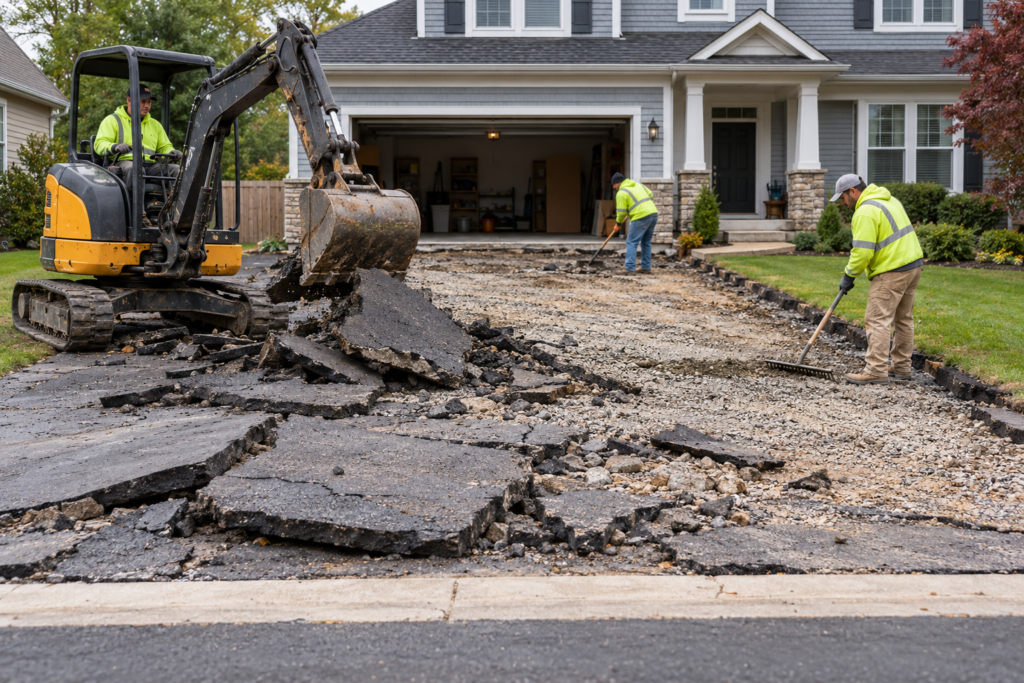
Replacing a driveway means paying for two connected jobs: removing what is there now and building a suitable new surface. As a broad US planning range, a full replacement commonly falls around $8–$18 per square foot, or approximately $4,800–$10,800 for a 600-square-foot driveway. Material choice, demolition, the condition of the existing base, drainage and access can move a real quote below or above that range.
That headline range is useful for early planning, but it is not a substitute for a site inspection. An asphalt-to-asphalt replacement may cost less than removing reinforced concrete and installing premium pavers. Ask contractors to separate demolition, disposal, base work, drainage and the new surface so you can compare the same scope.
Driveway replacement cost at a glance
| Planning item | Typical range | 600 sq. ft. example | Important limitation |
|---|---|---|---|
| Complete replacement | $8–$18 per sq. ft. | $4,800–$10,800 | Broad national range across different surfaces and site conditions |
| Asphalt removal | $1–$2 per sq. ft. | $600–$1,200 | Thick material, restricted access or extra hauling can cost more |
| Concrete removal | $2–$6 per sq. ft. | $1,200–$3,600 | Reinforcement, thickness and disposal rules affect demolition |
| New asphalt surface | $7–$13 per sq. ft. | $4,200–$7,800 | Published installed range; verify whether base work is included |
| New plain concrete | $8–$20 per sq. ft. | $4,800–$12,000 | Thickness, reinforcement and finish can change the price |
The safest way to use the table is to begin with the complete replacement range, then use the individual rows to question a quote. For example, if a contractor prices concrete demolition separately, confirm whether hauling and disposal are included before adding that item to the new installation total.
What does a driveway replacement price include?
A complete proposal should explain the whole journey from the old driveway to the finished surface. The word “replacement” does not guarantee that every contractor has included the same work.
- Demolition and removalBreaking, milling or lifting the old surface; loading debris; hauling it away; and disposal or recycling fees.
- Base assessment and repairChecking whether the existing aggregate base is stable, removing failed material, correcting soft areas and compacting replacement layers.
- Grade and drainageSetting the finished slope, correcting low spots and adding any channels or other drainage measures included in the design.
- New surface installationThe specified asphalt, concrete, gravel or paver system, including thickness, reinforcement, joints, bedding or edge restraint where relevant.
- Edges, apron and cleanupFinishing the connection to the street or garage, restoring disturbed edges and removing unused material and debris.
Some contractors combine these items into one square-foot rate; others show separate prices. Either approach can be valid if the scope is clear. A low figure that assumes the existing base can remain is not directly comparable with a quote that includes complete excavation and rebuilding.
Driveway replacement cost by size
The examples below multiply the broad $8–$18 replacement range by area. They are planning calculations, not surveyed contractor bids.
| Driveway area | Example dimensions | Low planning figure | High planning figure |
|---|---|---|---|
| 300 sq. ft. | About 12 × 25 ft. | $2,400 | $5,400 |
| 480 sq. ft. | About 20 × 24 ft. | $3,840 | $8,640 |
| 600 sq. ft. | About 15 × 40 ft. | $4,800 | $10,800 |
| 900 sq. ft. | About 18 × 50 ft. | $7,200 | $16,200 |
| 1,200 sq. ft. | About 20 × 60 ft. | $9,600 | $21,600 |
Small projects can carry minimum equipment, delivery or crew charges, so their per-square-foot price may be higher. Large or long driveways may need more grading, drainage work and truck access than their area alone suggests. Measure the actual proposed surface rather than relying on labels such as “one-car” or “two-car.”
How the replacement material changes the budget
Gravel replacement
$ variable scope
Potentially lower surface cost, but demolition and base repair still matter.
- An existing gravel drive may only need regrading and new surface stone if its base and drainage remain sound.
- Replacing asphalt or concrete with gravel still requires removal and a stable, compacted foundation.
- Ask which aggregate grades and compacted depths are included.
Asphalt replacement
$8–$15 per sq. ft.
A common replacement choice, with base condition driving much of the risk.
- The published range includes removal of an existing asphalt surface and new paving.
- Confirm compacted asphalt thickness and whether failed base areas are included or priced separately.
- An overlay is a different, lower-cost scope and requires a suitable existing structure.
Concrete replacement
$10–$26 calculated range
Removal can be substantial, especially with thick or reinforced concrete.
- The planning range combines $2–$6 removal with $8–$20 plain-concrete installation.
- Ask for slab thickness, reinforcement, joints, finish, curing instructions and drainage details.
- Decorative borders, color or stamping can push the project beyond this plain-finish calculation.
Paver replacement
$12–$36 calculated range
Higher initial cost, with excavation, bedding and edge restraint central to the job.
- The illustration combines $2–$6 concrete removal with the site’s $10–$30 paver installation band.
- Vehicle-rated pavers, the base, bedding and edge restraints should be specified.
- Premium natural stone and intricate patterns may exceed the planning range.
The concrete and paver figures above are transparent calculations from separate published planning bands, not quoted package prices. There can be overlap between “removal,” “site preparation” and “installation” in real estimates, so do not add generic rates to a contractor total without checking the scope.
Should you replace, repair or resurface?
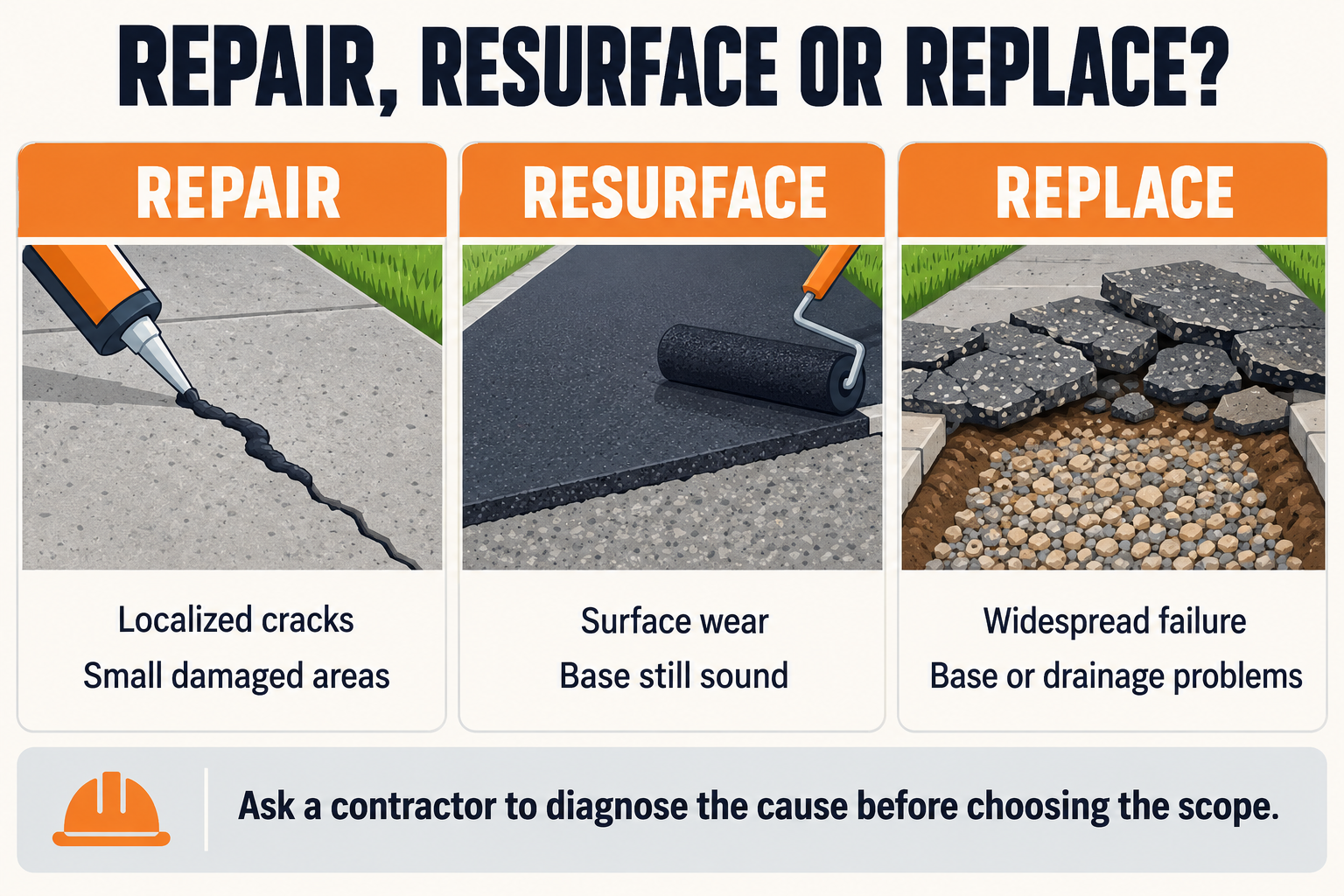
Replacement is the most extensive option. It removes the existing surface and deals with failed foundation or drainage work before a new driveway is installed. It is worth discussing when damage is widespread, the surface has extensive movement, low areas keep returning, or the base has failed.
Resurfacing adds or applies a new surface over a suitable existing structure. Published guides place resurfacing below full replacement, but it cannot correct every structural problem. If cracks, sinking or ponding come from the base, covering the surface may hide rather than solve the cause.
Repair targets limited defects such as individual cracks, small potholes or isolated damaged sections. It may be sensible when most of the driveway remains stable. Our repair cost guide compares crack filling, pothole patching, concrete leveling and material-specific repairs. Ask whether the repair is expected to prevent further deterioration or mainly improve appearance.
A contractor should diagnose the condition before recommending the scope. If the decision is uncertain, request two itemized options: resurfacing only if the structure is suitable, and full replacement showing the removal and base work. That makes the price difference meaningful.
What can increase the cost?
- A failed base: Soft, moving or poorly compacted material may need to be excavated and rebuilt rather than reused.
- Thick or reinforced concrete: Reinforcement and slab thickness increase cutting, breaking, loading and disposal work.
- Difficult access: Gates, walls, landscaping, overhead restrictions or a narrow route can limit machinery and truck access.
- Drainage corrections: Persistent standing water may require grading changes, channels or other site-specific measures.
- Steep or irregular layouts: Curves, slopes, turnarounds and multiple levels add setting-out and installation time.
- Street and curb work: Altering an apron, sidewalk, curb or public right-of-way may require a permit or approved contractor.
- Decorative finishes: Stamped or colored concrete, borders, patterns and premium pavers increase material and labor costs.
- Local disposal requirements: Haul distance, tipping fees and recycling options vary by location and material.
What happens during replacement?
- Site inspection and measurements: The contractor records dimensions, access, levels, drainage and visible failure.
- Scope and permits: The proposal identifies demolition, new construction and responsibility for local approvals.
- Old surface removal: The driveway is broken, milled or lifted, then hauled for recycling or disposal.
- Base inspection: The exposed foundation is assessed; unsuitable areas are removed, corrected and compacted.
- Drainage and grading: Levels are established so the finished driveway sheds water appropriately.
- New surface: Asphalt, concrete, gravel or the paver system is installed to the agreed specification.
- Curing or opening: The contractor explains when people and vehicles may use the surface and provides maintenance instructions.
Weather and material affect the schedule. Ask for an estimated start date, working duration and vehicle-use restriction, but allow for conditions that cannot be confirmed until the old surface has been removed.
How to compare driveway replacement quotes
Invite at least two or three suitable local contractors to inspect the same area. Give each the same preferred material and intended use, then compare these details rather than totals alone:
- Measured area, finished dimensions and any apron, parking pad or turnaround.
- Existing surface thickness and the demolition method.
- Hauling, recycling or disposal fees.
- How the existing base will be assessed and what base work is included.
- Compacted layer depths, material specifications and reinforcement where relevant.
- Finished grade, drainage measures and edge treatment.
- Permit responsibility and any public-street or curb work.
- Start date, duration, payment stages, warranty and exclusions.
Pay particular attention to allowances such as “base repair if required.” Ask for the unit price, how the quantity will be measured, who authorizes additional work and how you will receive the change in writing. A replacement project can reveal hidden base problems, but the process for pricing them should not be hidden.
Worked example: why the cheapest total may not be the lowest comparable price
Imagine two invented quotes for a 600-square-foot asphalt replacement. Quote A is $5,600 and Quote B is $6,500. A appears $900 cheaper, but it excludes disposal and assumes the entire base can remain. B includes hauling and up to two inches of localized base correction.
Before choosing, ask A to price disposal and explain the cost if failed base material is found. Ask B how additional work beyond its allowance would be measured. Once both scopes show the same work, compare the revised totals, specification, warranty and contractor suitability. These figures are illustrative only; they are not contractor bids.
Frequently asked questions
How much does it cost to replace a 600-square-foot driveway?
Using the broad $8–$18-per-square-foot planning range gives approximately $4,800–$10,800. A straightforward asphalt replacement may fall within a narrower material-specific band, while reinforced-concrete demolition, major base work or premium pavers can cost more.
Is driveway removal included in the replacement cost?
It should be, but contractor wording varies. Ask the proposal to state demolition, loading, hauling, disposal or recycling and cleanup explicitly. If removal is a separate line item, confirm that it is not also included within another rate.
Can the old driveway base be reused?
Sometimes. A stable, correctly graded base may be retained in whole or in part, but soft areas, movement or drainage problems can require rebuilding. The contractor should explain how the base will be assessed after the old surface is removed and how unexpected work will be priced.
Is resurfacing cheaper than replacement?
Usually, because it avoids complete demolition and much of the rebuilding. It is only a fair option when the existing structure can support the proposed treatment. Resurfacing a failing base can lead to recurring cracks, settlement or drainage problems.
How long will driveway replacement take?
Demolition and installation may take several working days, but size, weather, access, base repairs and material all affect the schedule. Concrete also needs appropriate curing time; asphalt and pavers have their own opening instructions. Follow the installer’s written guidance before parking vehicles.
Do I need a permit to replace a driveway?
Requirements vary by municipality. Work within the property may be treated differently from changes to a curb, sidewalk, apron or public right-of-way. Check with the local authority and establish in writing whether the homeowner or contractor obtains any approval.
Can I replace asphalt with concrete or pavers?
Yes, subject to site conditions and local requirements. The new system may need a different excavation depth, base, edge detail or drainage approach. Ask contractors to price the conversion as a complete design rather than treating it as a simple surface swap.
How these figures were calculated
We reviewed published US pricing guides in October 2026. Angi reports a broad $8–$18-per-square-foot range for replacement, while HomeGuide reports $4–$15 per square foot including removal. We use the more cautious $8–$18 band for the general planning examples because the page addresses complete professional replacement rather than the cheapest possible redo.
For material examples, Angi reports $8–$15 per square foot for asphalt replacement, including a stated removal component. Its 2026 guides report $2–$6 per square foot for concrete removal and $8–$20 for plain concrete installation. The $10–$26 concrete example adds those two reported bands. The paver example adds the same concrete-removal band to this site’s $10–$30 paver-installation planning band.
Those calculations show possible budget components; they are not a national bid database, median prices or guarantees. Publisher definitions can overlap, and local labor, materials, disposal, permits and site conditions vary. Use the figures to prepare questions, then rely on itemized local written estimates for a purchasing decision.