US driveway planning
Driveway Repair Cost: Cracks, Potholes and Common Fixes
Driveway repair costs commonly range from $100–$400 for minor work and $600–$3,000 for larger repairs. Compare asphalt, concrete, gravel and paver repair prices.
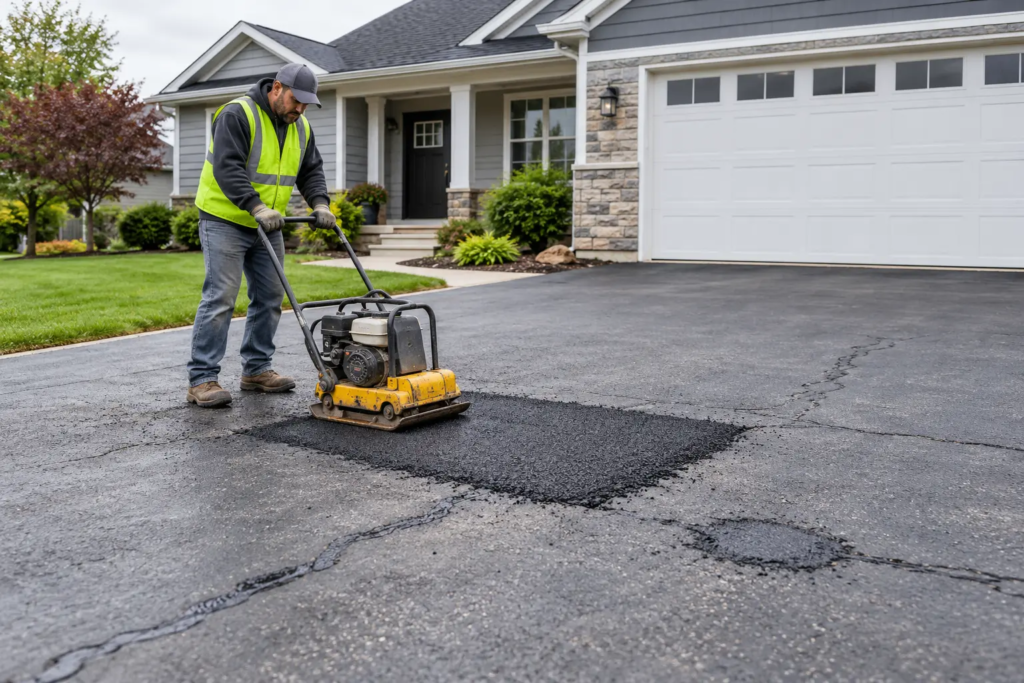
Driveway repair costs commonly range from $100–$400 for minor crack filling or a small pothole patch, while larger repairs often fall around $600–$3,000. Asphalt repairs are frequently priced at about $2–$5 per square foot and concrete repairs at roughly $3–$8 per square foot. Your actual price depends less on the driveway’s total size than on the damage, repair method, access and whether the base or drainage has failed.
These are national US planning ranges, not a substitute for an on-site diagnosis. A surface crack that can be cleaned and sealed is a very different job from a sunken slab or recurring pothole caused by water and weak base material. Ask contractors to identify the cause before pricing the visible symptom.
Driveway repair cost at a glance
| Repair | Typical planning range | How it is usually priced |
|---|---|---|
| Minor crack filling | $0.50–$3 per linear foot | Often subject to a contractor minimum charge |
| Pothole patch | $100–$400 each | Additional potholes may cost less per hole |
| Asphalt patching | $2–$5 per sq. ft. | Basic patching; saw-cut or infrared methods may cost more |
| Concrete repair and patching | $3–$8 per sq. ft. | Varies with crack depth, finish and preparation |
| Concrete leveling | $3–$25 per sq. ft. | Method, void size and access create a wide range |
| Major repairs or resurfacing | $600–$3,000 total | Broad national range; whole-drive resurfacing is a separate scope |
A commonly cited national average is around $1,200, but averages can be misleading. One sealed crack may cost only a minimum visit charge, while lifting several settled concrete panels can cost thousands. Start with the repair method rather than a single average.
Driveway repair cost by problem
Crack filling
Professional crack filling commonly costs about $0.50–$3 per linear foot. A contractor may still charge approximately $100–$150 or more to mobilize for a very small job. Narrow, stable cracks are generally cheaper than wide, contaminated or moving cracks that require routing, cleaning, backer material or flexible sealant.
Crack filling is intended to reduce water entry and slow deterioration. It will not restore a failed base or guarantee an invisible color match.
Pothole patching
A small pothole repair commonly falls around $100–$400. The repair should include removing loose material, preparing sound edges, addressing unstable material below and compacting the patch. Simply placing mix into a wet or crumbling hole may be cheaper, but it is unlikely to deliver the same life.
Sunken concrete and uneven slabs
Concrete leveling can range from roughly $3–$25 per square foot. Mudjacking, polyurethane foam injection, void depth, access and the number of slabs all affect the price. Leveling may improve drainage and reduce trip edges when the concrete remains sound, but it does not repair badly fractured slabs.
Edge failure and crumbling areas
Localized asphalt edge failure may be cut out and patched, while broken concrete corners or panels may need partial removal and repouring. Costs depend on the minimum practical repair area, reinforcement, edge support and whether vehicles must cross the repair.
Drainage-related repairs
If water repeatedly collects in the same area, the repair may need more than filler or patch material. Regrading, a channel drain, corrected downspout discharge or base reconstruction can increase the price but may prevent the defect returning.
Repair costs by driveway material
Asphalt repairs
$2–$5 per sq. ft.
Usually repairable in localized areas when the surrounding pavement and base remain stable.
- Crack filling is commonly priced by linear foot.
- Basic hot or cold patching commonly falls within the headline range.
- Saw-cut repairs may cost about $4–$12 per square foot because failed material is removed to defined edges.
Concrete repairs
$3–$8 per sq. ft.
Repair method depends on whether the issue is a crack, surface wear, settlement or a failed slab.
- Small cracks may be sealed, while spalled areas can require patching or resurfacing.
- Settled but otherwise sound slabs may be candidates for lifting.
- Badly broken panels may need section replacement rather than cosmetic repair.
Gravel repairs
$50–$450 common total range
Low material cost can hide drainage, grading or base problems.
- Light maintenance may involve raking, filling ruts and adding surface stone.
- Recurring washouts usually require correction of slope or water flow.
- Ask whether new gravel includes grading and mechanical compaction.
Paver repairs
$ scope dependent
Individual units can often be reused, but labor and base correction determine the cost.
- Sunken pavers are lifted so bedding and base levels can be corrected.
- Broken units may need matching replacements.
- Edge restraint failure or widespread movement can expand the repair area.
What does the driveway damage mean?
The appearance of damage offers clues, but it does not always reveal the cause. A contractor should inspect the surrounding surface, base, slope and water flow before recommending a repair.
- One or two narrow cracksMay be suitable for cleaning and flexible filling if the sides remain level and stable.
- Alligator or interconnected crackingOften indicates failure below the surface; repeated crack filling may not be economical.
- A potholeRequires loose material to be removed and may expose a wet or weak base.
- A sunken concrete panelMay be liftable if sound; severe cracking can make partial replacement more appropriate.
- Standing waterSuggests a grading, settlement or drainage problem that surface sealer cannot correct.
- Gravel washoutsMay need grading, drainage work and correctly sized aggregate rather than more top stone alone.
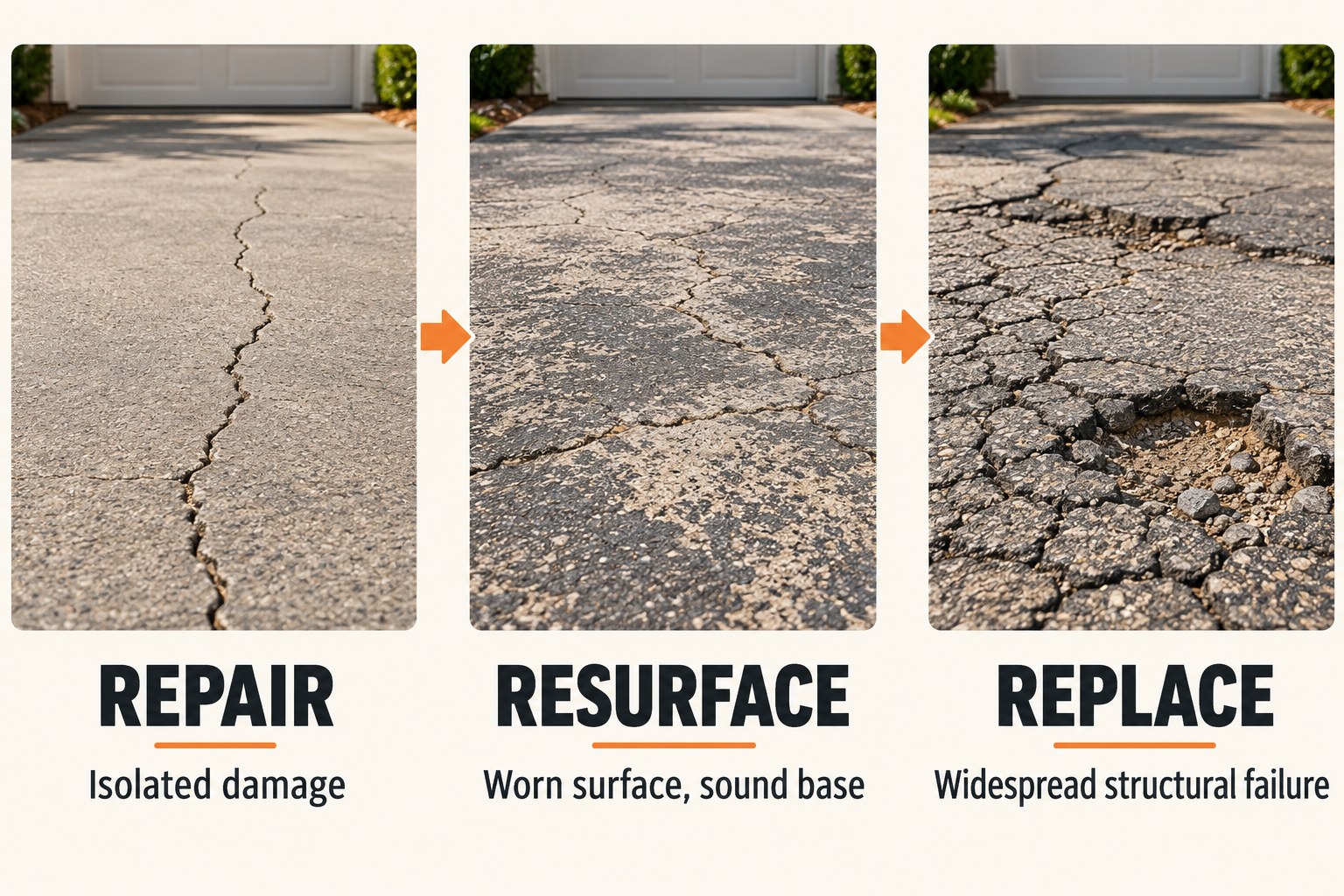
Should you repair, resurface or replace?
| Option | Usually suits | Planning cost | Main limitation |
|---|---|---|---|
| Repair | Isolated cracks, potholes, settled sections or localized damage | Often $100–$400 for small work; $2–$8 per sq. ft. for common patching | Does not solve widespread base failure |
| Resurface | Worn or moderately damaged surface over a generally sound structure | About $1–$3 per sq. ft. for asphalt; $3–$7 for concrete | Not suitable for major movement, drainage or foundation problems |
| Replace | Widespread structural failure, repeated sinking or severe cracking | Broadly $8–$18 per sq. ft. | Highest initial cost and disruption |
Repair is usually the first option when damage is limited and most of the driveway remains stable. Resurfacing becomes relevant when defects are more widespread but the base is sound. Replacement is more likely when failures recur or the foundation and drainage need reconstruction.
For the full removal-and-rebuild calculation, see our driveway replacement cost guide. A contractor who recommends replacement should explain why repair or resurfacing would not provide reasonable value.
What changes the repair price?
- Contractor minimums: Travel, equipment and setup can dominate a small job.
- Damage depth: A surface defect costs less than rebuilding part of the base.
- Repair geometry: Several scattered areas require more cutting, preparation and movement than one compact patch.
- Access: Narrow gates, walls, landscaping and steep grades can restrict equipment.
- Water and drainage: Correcting the source of erosion, settlement or freeze-thaw damage adds work but can improve longevity.
- Finish matching: Existing surfaces weather over time, so a sound repair may remain visible.
- Season and urgency: Emergency work and unsuitable weather windows may cost more or limit repair methods.
- Permits: Work involving a sidewalk, curb, apron or right-of-way may need local approval.
Can you repair a driveway yourself?
A careful homeowner may be able to clean and fill a small stable crack, patch a minor asphalt pothole or redistribute gravel. DIY work is most appropriate when the problem is clearly localized and there is no evidence of settlement, drainage failure or undermining.
Professional assessment is sensible for wide or moving cracks, repeated potholes, trip hazards, sunken slabs, drainage near the house, extensive alligator cracking or damage involving the street connection. Heavy lifting, cutting and compaction also introduce safety and equipment requirements.
Before excavation, follow local utility-location requirements. Product instructions control preparation, temperature, curing and when vehicles can return.
How to compare driveway repair quotes
Ask two or three appropriate local contractors to inspect the same damage. Photographs can help initially, but settlement and base condition may require an on-site visit. Compare:
- The measured length or area of each repair.
- The diagnosis of the underlying cause.
- How loose or failed material will be removed.
- Cleaning, edge preparation, primer or bonding steps.
- Repair material, installed depth and compaction method.
- Any base, drainage or leveling work included.
- How the finish and color may differ from the existing driveway.
- Vehicle-use restrictions, warranty and exclusions.
Be cautious when quotations use the same word—such as “patch”—for different scopes. A surface patch, a saw-cut full-depth asphalt repair and a reconstructed concrete panel are not comparable simply because they cover the same area.
Frequently asked questions
How much does it cost to repair a driveway?
Minor crack or pothole repairs commonly cost about $100–$400, while larger repairs or resurfacing may range from roughly $600–$3,000. Asphalt repair is often around $2–$5 per square foot and concrete repair around $3–$8, subject to minimum charges and method.
Is it worth repairing an old driveway?
It can be if damage is localized and the surrounding driveway and base remain stable. If repairs recur across a large area, drainage is poor or the surface shows widespread structural failure, resurfacing or replacement may provide better value.
How much does it cost to fill driveway cracks?
Professional crack filling commonly costs around $0.50–$3 per linear foot, but a small project may be billed at the contractor’s minimum visit charge. Wide, deep or moving cracks can need a different repair.
How much does pothole repair cost?
A small driveway pothole commonly costs around $100–$400 to repair. Multiple potholes, failed base material, water problems or restricted access can increase the total.
Can cracked concrete be repaired without replacement?
Small stable cracks and localized surface damage often can be repaired. A settled but sound slab may be lifted. Badly broken, displaced or structurally failed panels are more likely to need partial or full replacement.
Does sealing a driveway repair cracks?
No. Sealcoating or sealer can protect a suitable surface, but cracks and potholes should be repaired first. Sealer does not correct settlement, drainage or base failure.
How long should a driveway repair last?
There is no single lifespan. It depends on method, preparation, surrounding pavement, drainage, climate and traffic. Ask what the repair is designed to achieve and what warranty applies.
Should I repair the driveway before selling my home?
Repairing trip hazards, loose areas and conspicuous potholes may improve safety and presentation. Compare the cost with the likely benefit, and avoid covering structural problems without correcting their cause.
How we researched these costs
We compared current US consumer cost guides and separated crack filling, patching, leveling, resurfacing and replacement wherever possible. Published prices vary because providers define “repair” differently and local labor, materials, climate and site conditions matter. These are planning figures, not quotations.
- HomeGuide: Driveway Repair Cost (2026)
- Angi: Concrete Driveway Repair Cost (2026)
- Angi: Asphalt Driveway Repair Cost (2026)
- Angi: Patch, Resurface or Replace
Last reviewed: October 2026. Prices exclude unusual structural, drainage, permit and access requirements unless stated.